
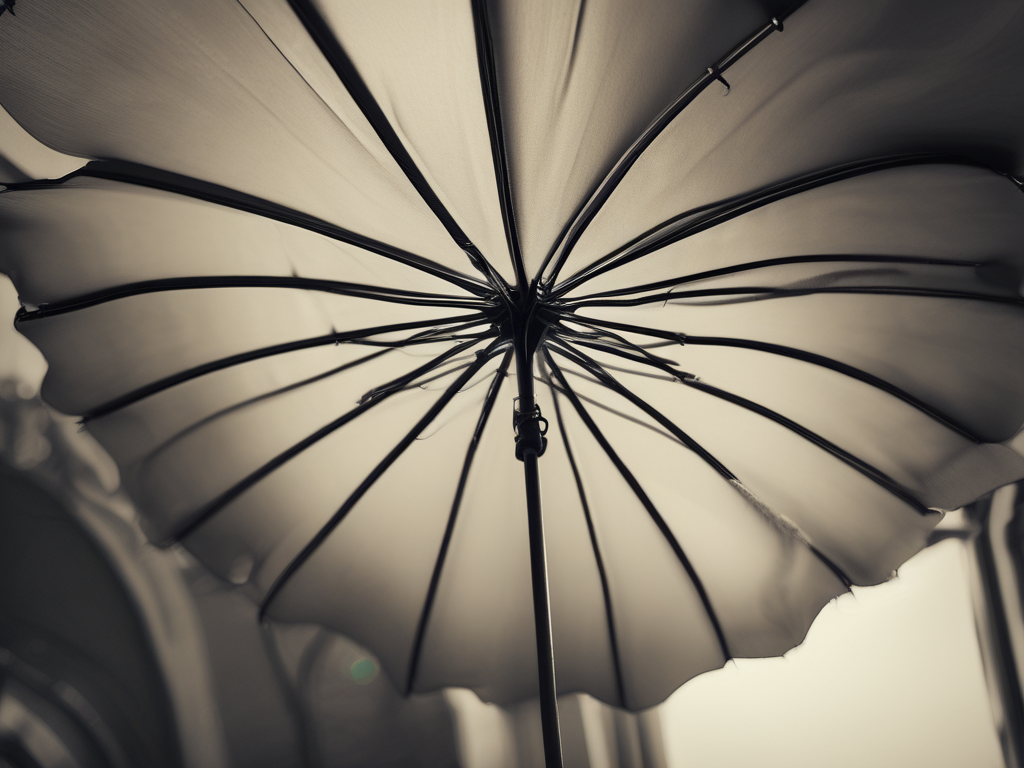
I have long questioned the purpose of umbrellas. With a sudden gust they blow inside out in the wind, and in bursts the rain with no invitation. Only a broken umbrella then remains. The aftermath of any storm is testament to this; the land becomes an umbrella graveyard – they stick out of bins, or people abandon them outright and leave them strewn on pavements and in gutters.
Still, the umbrella under which I currently find myself is as sturdy at they come as the rain pelts down. There remains the need to keep a firm hold as the gusts attempt to take it away, and my social vertigo sees a situation in which I am charged with the grave offense of causing injury and calamity through improper umbrella yielding.
As I lie here, I contemplate whether I could ever otherwise be persuaded to prostrate myself in the road in such a downpour. Rain is generally something I attempt to avoid at all costs. Usually the second skin of the caravan in which I live provides the protection I need to prevent it from beating down on my body, though I am still close enough to feel the beating on the roof that brings the fullness of gratitude as to my proximity to it without it bearing down upon me.
Next to the umbrella stands Charlie. I am feeling a depth of gratitude not only to the umbrella for so adequately providing my current second skin, but to Charlie for so proficiently preventing the squishing of my delicate skull as the cars roar past. The emotion of each driver can be felt by the revs from the engine. I become even more greatly attuned to the feelings of particular drivers as they choose to halt in the road, scroll down their electric windows and yell, “Wankers! I’m trying to get to work!” I suspect from this call some undealt with anger.
I lie in the road, swamped with soggy blankets and bits of old fabric, with my left arm in a tube, which is surrounded by another tube. My wrist has a chain around it, which is held to a length of metal in the centre of the tube by way of a carribena. The other half of the tube is shared with me by Gail’s arm. On the end of Gail’s arm is Gail, and she is having a wail of a time, singing, “Why don’t we do it in the road?” by the Beatles and merrily giving speeches to iPhones.
Stu comes over and points an iPhone in my direction. I have a general loathing of cameras of all kinds, as the belief which some Native American cultures have followed that photography will steal your soul and is a disrespect to the spirit world resonates strongly with me. Still, seeing as we’ve so fully disrespected the spirit world and have very little left of our souls anyhow, I comply for the sake of the cause.
“It’s my birthday today!” I say to the camera excitedly. “And this is the best thing I could possibly think of to do!”
“Happy birthday!” says Stu, and then tells me that little messages are popping up from various locations on Planet Earth to wish me many happy returns. “Someone says he spent his birthday in a protest at Standing Rock,” Stu tells me. I am touched by this. As little pieces of my soul ping around the planet, I am brought to feel that we can at least use our soul-sucking technologies for something soulful every now and then.
Another “Wanker!” call slices through the sound of the traffic and the rain.
“I’m a wanker,” I say thoughtfully, wishing that I was not slightly pained with every passing insult. If broken down and properly probed, reams of writing could be produced on what is held in the angry hurling of that single word.
“I’m a wanker,” I start to sing, and Gail joins in, “We’re the wankers, we’re the wankers, we lie in the road just to make you late, we’re the wankers,” and we wiggle our wellies back and forth as we do so.
I lift the umbrella tentatively in an attempt to catch a glimpse of my other colleagues, Poh-Eng and Jo on the other side of the road, slightly staggered from us so that cars may pass on their way to work, but an articulated lorry would find itself in a true pickle by trying to pass. All I can see is what looks like a roll of fabric and a roll of carpet, each with its own umbrella. I presume these rolls to hold beating hearts within, beating yet more with the adrenaline of the tension, and soft skin which, like my own, does not tolerate well the torrents of rain.
The police arrive. “I’m so sorry about what they’ve done to police pensions,” Gail says to them as they approach us. We tell them how long we intend to be there and when we intend to self-release from our arm lock tube. There is some considerable back and forth and they all make a neon yellow penguin huddle to work out what to do. Various officers come and go, each expressing extreme concern for our welfare as the main reason for wishing us to leave the road. We assure them that we are quite comfortable and receiving adequate protection from our colleagues. They ask if we would be willing to get up of our own accord. We tell them that we will surely do this at the time that we have given them. They say this is not good enough. They allot each of us with our own personal officer and other officers stand around trying to look like they have something to do. My officer is young and has a kind face and giggles at the jokes of the other officers.
Outside my umbrella, a man is singing a sweet sweet song. As his song finishes, he ducks down underneath the umbrella to talk to me.
“I’ve got some cake,” he says, “Would you like it?”
“Did you know that it’s my birthday today?” I say excitedly.
“No, I had no idea!” he exclaims. “It’s perfect then,” and he nips off and in a jiffy he’s back with a polystyrene tray. He hands it to me and tells me of an explorer who traversed the far reaches of the arctic, and when asked how he could do it, his reply was, “because of hedonism”.
“You see”, the man with the sweet singing voice told me, “When you do anything so extreme and so brutal, the merest square of chocolate or flicker of warmth will feel like nothing has ever been so good.”
I peel back the squeaky polystyrene lid, and there it is, a glorious piece of lemon cheesecake embossed with strawberries and mint leaves. And as the rain pelts down and the cars roar past with their “Wanker!” cries and I come to realise that I am so soaked through that the umbrella is actually just about as useless as my previous judgment of umbrellas, and the police crowd round and my arm starts to feel the tightness of the tube, I take a taste of the lemon cheesecake and it truly is the best taste of cake, nay just about anything, that I have ever enjoyed.
I am so soaked through that I am starting to get cold, as is my personal police officer, who is shivering and teeth-chattering and nose-blowing. In such a situation, I have the advantage over my officer as I can make a request for hot drinks. Lizzie goes off in search of tea and returns some time later. I know deep down that to drink tea is utterly foolish as it will exacerbate greatly my desire to empty my bladder, but I am so entirely seduced by the idea of hot liquid that I allow myself to indulge.
Time rolls by as does the traffic, car by car by car by car. At 8am they ask us for a final time if we would be willing to get up of our own accord. They put us through a 5 step questioning process, which goes something like, “Step 1: Mumble mumble jumble mumble…are you willing to get up from the road?”. After five mumbo jumbo steps, they remain unhappy with our persistent answer that we’ll be happy to remove ourselves at the time we’ve given them, and the chief officer makes instructions for our arrest. My personal officer performs the arrest, which she does with quite some awkwardness. As Gail and I are still very much attached to our tube, nothing much changes for quite some time after we have been arrested.
Simon appears and Gail reminds him that it’s my birthday. “Of course it is!” he says enthusiastically. “Would you mind if I sing happy birthday?” I give him the go-ahead, and with characteristic immoderation, his hearty, booming voice whips everyone in the area into a round of happy birthday.
A woman appears in front of the umbrella to ask me something, and I have no idea what it might be in the thundering traffic and rain. “I’m sorry, I can’t hear you!” I shout back, “Can you say that again but louder?” She repeats herself at the exact same volume. “Sorry, I don’t know what you’re saying!” I yell again. She says the same thing again and I still have no idea what it is but she looks very nice and as if she has my best interests at heart, so I smile broadly and give her a thumbs up, or more a thumb up as I only have one hand to hand. A few minutes later she returns with a hot water bottle, an object of true divinity at this moment and I hold it to my kidneys and feel fabulous.
An hour later the cutting team arrives. They wear head-to-toe waterproof suits that make them look somewhat like penguins but rather more ridiculous and less endearing. Another police officer takes us through another five step process. This time I manage to catch one of the steps, which is something like, “With the knowledge of what your action is doing to the community in terms of the time and resources it is taking up, would you be willing to self release?” I tell her that I believe I am doing this for the community, not to waste its time, and she dutifully writes down what I say on a clipboard with a cleverly raised plastic cover to prevent her evidence from soggyfying. At the end of the five step process, a gazebo is mounted above us and I am stripped of my second skin, my beloved umbrella, and left exposed to the crowd of police around me.
I start to need to pee. I’m wearing an incontinence pad and I wonder if I will be able to use it. After all, nobody will actually know I am peeing. I think about how much I need to pee and how small the incontinence pad seems by comparison with the quantity of pee there is in my bladder and I feel no faith that emptying my bladder right now is the right thing to do. And in any case, I was potty trained at such a young age not to pee in my pants that it goes against way too many years of conditioning to allow myself this liberty.
The world slows down. The cutting team mill around above us. I feel my free arm jerked up and I realise that a police officer has grabbed it so that she can look down the tube. She has a mean, pinched face and I ask what she thinks she’s doing. She makes her reply and I tell her firmly, “If you need to touch my arm, you need to ask first. That’s what’s respectful. ” She smirks at me and disappears off somewhere.
The cutting team are utterly genial and give great assurance of the safety of our arms. They spend a long time setting up their operation, and the time gets closer and closer to our time of self-release. We are given eye shields and ear defenders to prevent us from the flying sparks of the angle grinder as it penetrates through the tube. In my one-armed state, I ask for assistance in putting them both on and immediately feel a great sense of peace as the sights and sounds of the intensity of the world right now are so utterly dulled around me. They start to cut through the tube and I barely hear the sound, though the acrid smell of smoke pierces my nostrils. Every now and then a member of the cutting team gives me a nudge to check I’m okay. I’m soaked through and very cold, but really, my greatest concern is more than anything right now my need to pee.
I start to wonder what the point is in having called the cutting team as the time of our self-release is fast approaching, and in the final seconds our colleagues around us do a countdown, and to the surprise of the officers around us, we call out that we are going to unclip ourselves and in a moment it’s all over. Gail is the first to be taken off and whisked into a police van, singing as she goes. I am left to stand shivering with my personal cop and the pinched-faced officer. Across the road, Jo and Poh-Eng are getting up, and Jo is shouting in distress. “You should be ashamed of yourselves!” she yells at the police. “This is abuse!” And I realise fully for the first time that we are all playing a game, we are all shrouded in laws and rules and institution and we play this game, this very fine line of a game, and if for a moment we allow ourselves to be in the reality of this situation and not just playing the game, we leave ourselves open to the terror of our powerlessness. This whole situation is institutional abuse of power.
I can do nothing right now so I play the game, and in any case my desperation to pee is so intense I’m starting to have some kind of transcendental experience. Finally Poh-Eng and Jo are taken away and I am left held by the police, my colleagues still present and the detritus of our protest lying limp in the road as I wait and wait for a van to turn up to take me away. Simon whips up another round of “Happy birthday” and the pinched-faced cop says, “Get that one in the main van”. This time I don’t manage to point out that I am a subject of my own experience, not a mere thing to be dealt with, and they march me off to a van with numerous officers and lock me in a tiny barred cell at the back.
Eventually, a smaller van arrives to take me to the police station and I am accompanied by my arresting officer. When we finally arrive, I am taken through the grim barred building and told that there is no room in the holding cells. I am returned to the back of the police van, where I sit with my head in my hands waiting for my bladder to explode as my arresting officer tries to make small talk with me.
After what seems like another age, there is finally a space in the holding cells for me. The officer walks me into a room with a line of four cubicles. I sit in the empty one, catching a glimpse of Poh-Eng and Jo in the others. Gail is at the desk on the other side of the glass wall giving her details. I ask if I can pee and an officer instructs my arresting officer to attract the attention of someone on the other side of the glass. She makes a terrible job of it. I can see how lacking in assertiveness she is; she’s young and sweet and terrified of doing the wrong thing. She tentatively taps on the glass and is ignored, so she goes back to giggling at the jokes of the other officers present. My inability to empty my bladder is making me start to lose my mind.
To add to the sensation of insanity, the fourth cubicle is occupied by the Obligatory Aggravating Being; the one whose role it is to rock up and drive everyone up the wall. He is whinging and whining and unpleasant and above all utterly unable to remain silent for more than a second. I can’t see him because of the rigid line of the cubicles, and all I hear is his voice, droning on relentlessly.
“Go on,” he whines, “Just half a cigarette, go on, take me out for half a cigarette, go on, please take me out, I don’t understand why you won’t take me out, go on I haven’t done nothing. Fucking cops, I haven’t done nothing, go on…” and then, to one of the female officers present, “You know, I think you might be the woman of my dreams.” The collective eye-ball rolling in the room is palpable. “What’s your name? Samantha? No? Okay, must be Belinda. How about Lydia? Yes, Lydia seems about right. Go on, tell me you name, you’re the woman of my dreams…” I note with interest how my allegiance shifts from being on the other side of the divide from the police that hold me captive to the unspoken understanding between all the women in the room of what it is to live in a male-dominated culture, in which men will still find ways to belittle even from positions of powerlessness.
Finally, the opportunity arises for my arresting officer to attract someone’s attention, and I am led to a toilet cubicle where I pee behind a curtain. I pee for about two minutes straight. The following relief is akin to the bliss of the lemon cheesecake.
I am returned to the holding cell. Jo and Poh-Eng have both been processed and after not much longer the Aggravating Being is taken off to be processed himself. Another blessed moment comes as he leaves. Then finally it is my turn. I am taken to the desk for processing and asked all sorts of questions about whether I can read and if I’ve been having suicidal thoughts. They give me a set of clothes – a grey t-shirt, jogging bottoms and sweater and I am taken to a cell to get changed. I peel off my sodden clothes. They are so soaked that they leave pools of water all over the floor. I am taken to my own custody cell where I curl up in a blanket and read my book; the only thing about my person that has managed to remain unsodden in a pocket of my jacket. It is a self-help book by Brene Brown entitled “Daring Greatly”. I sometimes wonder if I might be a self-help book junky. There is something comforting about them, like a cuddly teddy bear that believes in you even when the rest of the world seems hostile or unconcerned.
The words of her book are indeed a healing balm; The people in this world, she writes, who have a strong sense of love and belonging in their lives believe that they’re worthy of love and belonging. They know that in order for connection with others to happen, you need to allow yourself to be seen. You need to let go of who you think you should be and become who you are. So you need to allow your vulnerability, for this is what will enable you to live with a whole heart; with the courage to be imperfect and make mistakes, but to be your authentic self, which allows for connection. The people who believe they are worthy of love and belonging fully embrace their vulnerability, because they know that what makes them vulnerable makes them beautiful. At the core of vulnerability is shame; the fear of disconnection, of not being worthy of connection because of the belief that you are not enough. But vulnerability is also the birthplace of joy and love and being fully alive. If you numb out the pain and discomfort of vulnerability, through medicating or blaming other people or whatever you do to not feel the pain and discomfort, you also numb out joy and gratitude.
I lie alone on my bunk and start to dose, with feelings of joy and gratitude washing over me. What a beautiful birthday it has been so far, even incarcerated in this loveless cell.
Some time later, I am woken up, ushered back to the main help desk, asked a bunch more questions and given a date to appear in court. I am given back a whole sack of my soggy belongings and finally I am released out into the delicious fresh air. The rain clouds have cleared and bright beams now rain down on me in place of the real rain. I stand in the car park, bemused, when Poh-Eng and Jo wave to me from a parked car. A local resident has come to meet us and take us back to camp. She’s been waiting in her car for hours to make sure there’s someone there for our release. I’m absolutely ravenous and it turns out that unlike me the others were given food in the cells. Poh-Eng comes with me to get chips and we run towards the city centre. We are in Blackpool of all places, all ticky tacky with a chip shop on every corner. We run to the sea and the spray splashes over us and we laugh in the bright light.
Back at the car Gail has arrived and off we drive and our lift tells us her story of being in the police force and seeing the light and quitting. She’s been involved in the campaign against fracking for a long time and she says that the site at Preston New Road is just the very beginning of what they want to frack. And I realise why I’m here, just having taken this tiny little action of only a few hours long, as part of something bigger, as a prayer that others will also feel a call to arms in whatever way makes sense to them.
And before I know it, we’re back to where we started. Back to the camp at Preston New Road. I see my arresting officer has now been stationed in front of one of the four lorries where four activists have been occupying the roofs of the lorry cabs for the past two days. Yesterday they risked heat stroke as they danced topless on those roofs in the burning sun. Today they have plastic bivii bags that have been sheltering them from the rain. I give my officer a grin. “Hello again!” I say to her. “Funny to see you back here!”. I see Jake and he has a great big smile on his face. It’s his first activist experience and he’s taken to it like a duck who’s discovered water for the very first time. He’s pedaling a bike with a full trailer, for the new wave of people who are lying in the road to prevent lorries entering the site with materials that will be used to frack the land. I think of what it means to be of this land, and how, way back in its history, the colonizing Romans feared the locals who themselves feared nothing, feared no death, such was the strength of their connection to the land; such was their conviction in their actions. We are of this land, whether old or new arrivals, and here we stand as modern day warriors, with no armour to protect us save for the second skin of an umbrella and the courage to allow our vulnerability to lead us.
I have long questioned the purpose of umbrellas. With a sudden gust they blow inside out in the wind, and in bursts the rain with no invitation. Only a broken umbrella then remains. The aftermath of any storm is testament to this; the land becomes an umbrella graveyard – they stick out of bins, or people abandon them outright and leave them strewn on pavements and in gutters.
Still, the umbrella under which I currently find myself is as sturdy at they come as the rain pelts down. There remains the need to keep a firm hold as the gusts attempt to take it away, and my social vertigo sees a situation in which I am charged with the grave offense of causing injury and calamity through improper umbrella yielding.
As I lie here, I contemplate whether I could ever otherwise be persuaded to prostrate myself in the road in such a downpour. Rain is generally something I attempt to avoid at all costs. Usually the second skin of the caravan in which I live provides the protection I need to prevent it from beating down on my body, though I am still close enough to feel the beating on the roof that brings the fullness of gratitude as to my proximity to it without it bearing down upon me.
Next to the umbrella stands Charlie. I am feeling a depth of gratitude not only to the umbrella for so adequately providing my current second skin, but to Charlie for so proficiently preventing the squishing of my delicate skull as the cars roar past. The emotion of each driver can be felt by the revs from the engine. I become even more greatly attuned to the feelings of particular drivers as they choose to halt in the road, scroll down their electric windows and yell, “Wankers! I’m trying to get to work!” I suspect from this call some undealt with anger.
I lie in the road, swamped with soggy blankets and bits of old fabric, with my left arm in a tube, which is surrounded by another tube. My wrist has a chain around it, which is held to a length of metal in the centre of the tube by way of a carribena. The other half of the tube is shared with me by Gail’s arm. On the end of Gail’s arm is Gail, and she is having a wail of a time, singing, “Why don’t we do it in the road?” by the Beatles and merrily giving speeches to iPhones.
Stu comes over and points an iPhone in my direction. I have a general loathing of cameras of all kinds, as the belief which some Native American cultures have followed that photography will steal your soul and is a disrespect to the spirit world resonates strongly with me. Still, seeing as we’ve so fully disrespected the spirit world and have very little left of our souls anyhow, I comply for the sake of the cause.
“It’s my birthday today!” I say to the camera excitedly. “And this is the best thing I could possibly think of to do!”
“Happy birthday!” says Stu, and then tells me that little messages are popping up from various locations on Planet Earth to wish me many happy returns. “Someone says he spent his birthday in a protest at Standing Rock,” Stu tells me. I am touched by this. As little pieces of my soul ping around the planet, I am brought to feel that we can at least use our soul-sucking technologies for something soulful every now and then.
Another “Wanker!” call slices through the sound of the traffic and the rain.
“I’m a wanker,” I say thoughtfully, wishing that I was not slightly pained with every passing insult. If broken down and properly probed, reams of writing could be produced on what is held in the angry hurling of that single word.
“I’m a wanker,” I start to sing, and Gail joins in, “We’re the wankers, we’re the wankers, we lie in the road just to make you late, we’re the wankers,” and we wiggle our wellies back and forth as we do so.
I lift the umbrella tentatively in an attempt to catch a glimpse of my other colleagues, Poh-Eng and Jo on the other side of the road, slightly staggered from us so that cars may pass on their way to work, but an articulated lorry would find itself in a true pickle by trying to pass. All I can see is what looks like a roll of fabric and a roll of carpet, each with its own umbrella. I presume these rolls to hold beating hearts within, beating yet more with the adrenaline of the tension, and soft skin which, like my own, does not tolerate well the torrents of rain.
The police arrive. “I’m so sorry about what they’ve done to police pensions,” Gail says to them as they approach us. We tell them how long we intend to be there and when we intend to self-release from our arm lock tube. There is some considerable back and forth and they all make a neon yellow penguin huddle to work out what to do. Various officers come and go, each expressing extreme concern for our welfare as the main reason for wishing us to leave the road. We assure them that we are quite comfortable and receiving adequate protection from our colleagues. They ask if we would be willing to get up of our own accord. We tell them that we will surely do this at the time that we have given them. They say this is not good enough. They allot each of us with our own personal officer and other officers stand around trying to look like they have something to do. My officer is young and has a kind face and giggles at the jokes of the other officers.
Outside my umbrella, a man is singing a sweet sweet song. As his song finishes, he ducks down underneath the umbrella to talk to me.
“I’ve got some cake,” he says, “Would you like it?”
“Did you know that it’s my birthday today?” I say excitedly.
“No, I had no idea!” he exclaims. “It’s perfect then,” and he nips off and in a jiffy he’s back with a polystyrene tray. He hands it to me and tells me of an explorer who traversed the far reaches of the arctic, and when asked how he could do it, his reply was, “because of hedonism”.
“You see”, the man with the sweet singing voice told me, “When you do anything so extreme and so brutal, the merest square of chocolate or flicker of warmth will feel like nothing has ever been so good.”
I peel back the squeaky polystyrene lid, and there it is, a glorious piece of lemon cheesecake embossed with strawberries and mint leaves. And as the rain pelts down and the cars roar past with their “Wanker!” cries and I come to realise that I am so soaked through that the umbrella is actually just about as useless as my previous judgment of umbrellas, and the police crowd round and my arm starts to feel the tightness of the tube, I take a taste of the lemon cheesecake and it truly is the best taste of cake, nay just about anything, that I have ever enjoyed.
I am so soaked through that I am starting to get cold, as is my personal police officer, who is shivering and teeth-chattering and nose-blowing. In such a situation, I have the advantage over my officer as I can make a request for hot drinks. Lizzie goes off in search of tea and returns some time later. I know deep down that to drink tea is utterly foolish as it will exacerbate greatly my desire to empty my bladder, but I am so entirely seduced by the idea of hot liquid that I allow myself to indulge.
Time rolls by as does the traffic, car by car by car by car. At 8am they ask us for a final time if we would be willing to get up of our own accord. They put us through a 5 step questioning process, which goes something like, “Step 1: Mumble mumble jumble mumble…are you willing to get up from the road?”. After five mumbo jumbo steps, they remain unhappy with our persistent answer that we’ll be happy to remove ourselves at the time we’ve given them, and the chief officer makes instructions for our arrest. My personal officer performs the arrest, which she does with quite some awkwardness. As Gail and I are still very much attached to our tube, nothing much changes for quite some time after we have been arrested.
Simon appears and Gail reminds him that it’s my birthday. “Of course it is!” he says enthusiastically. “Would you mind if I sing happy birthday?” I give him the go-ahead, and with characteristic immoderation, his hearty, booming voice whips everyone in the area into a round of happy birthday.
A woman appears in front of the umbrella to ask me something, and I have no idea what it might be in the thundering traffic and rain. “I’m sorry, I can’t hear you!” I shout back, “Can you say that again but louder?” She repeats herself at the exact same volume. “Sorry, I don’t know what you’re saying!” I yell again. She says the same thing again and I still have no idea what it is but she looks very nice and as if she has my best interests at heart, so I smile broadly and give her a thumbs up, or more a thumb up as I only have one hand to hand. A few minutes later she returns with a hot water bottle, an object of true divinity at this moment and I hold it to my kidneys and feel fabulous.
An hour later the cutting team arrives. They wear head-to-toe waterproof suits that make them look somewhat like penguins but rather more ridiculous and less endearing. Another police officer takes us through another five step process. This time I manage to catch one of the steps, which is something like, “With the knowledge of what your action is doing to the community in terms of the time and resources it is taking up, would you be willing to self release?” I tell her that I believe I am doing this for the community, not to waste its time, and she dutifully writes down what I say on a clipboard with a cleverly raised plastic cover to prevent her evidence from soggyfying. At the end of the five step process, a gazebo is mounted above us and I am stripped of my second skin, my beloved umbrella, and left exposed to the crowd of police around me.
I start to need to pee. I’m wearing an incontinence pad and I wonder if I will be able to use it. After all, nobody will actually know I am peeing. I think about how much I need to pee and how small the incontinence pad seems by comparison with the quantity of pee there is in my bladder and I feel no faith that emptying my bladder right now is the right thing to do. And in any case, I was potty trained at such a young age not to pee in my pants that it goes against way too many years of conditioning to allow myself this liberty.
The world slows down. The cutting team mill around above us. I feel my free arm jerked up and I realise that a police officer has grabbed it so that she can look down the tube. She has a mean, pinched face and I ask what she thinks she’s doing. She makes her reply and I tell her firmly, “If you need to touch my arm, you need to ask first. That’s what’s respectful. ” She smirks at me and disappears off somewhere.
The cutting team are utterly genial and give great assurance of the safety of our arms. They spend a long time setting up their operation, and the time gets closer and closer to our time of self-release. We are given eye shields and ear defenders to prevent us from the flying sparks of the angle grinder as it penetrates through the tube. In my one-armed state, I ask for assistance in putting them both on and immediately feel a great sense of peace as the sights and sounds of the intensity of the world right now are so utterly dulled around me. They start to cut through the tube and I barely hear the sound, though the acrid smell of smoke pierces my nostrils. Every now and then a member of the cutting team gives me a nudge to check I’m okay. I’m soaked through and very cold, but really, my greatest concern is more than anything right now my need to pee.
I start to wonder what the point is in having called the cutting team as the time of our self-release is fast approaching, and in the final seconds our colleagues around us do a countdown, and to the surprise of the officers around us, we call out that we are going to unclip ourselves and in a moment it’s all over. Gail is the first to be taken off and whisked into a police van, singing as she goes. I am left to stand shivering with my personal cop and the pinched-faced officer. Across the road, Jo and Poh-Eng are getting up, and Jo is shouting in distress. “You should be ashamed of yourselves!” she yells at the police. “This is abuse!” And I realise fully for the first time that we are all playing a game, we are all shrouded in laws and rules and institution and we play this game, this very fine line of a game, and if for a moment we allow ourselves to be in the reality of this situation and not just playing the game, we leave ourselves open to the terror of our powerlessness. This whole situation is institutional abuse of power.
I can do nothing right now so I play the game, and in any case my desperation to pee is so intense I’m starting to have some kind of transcendental experience. Finally Poh-Eng and Jo are taken away and I am left held by the police, my colleagues still present and the detritus of our protest lying limp in the road as I wait and wait for a van to turn up to take me away. Simon whips up another round of “Happy birthday” and the pinched-faced cop says, “Get that one in the main van”. This time I don’t manage to point out that I am a subject of my own experience, not a mere thing to be dealt with, and they march me off to a van with numerous officers and lock me in a tiny barred cell at the back.
Eventually, a smaller van arrives to take me to the police station and I am accompanied by my arresting officer. When we finally arrive, I am taken through the grim barred building and told that there is no room in the holding cells. I am returned to the back of the police van, where I sit with my head in my hands waiting for my bladder to explode as my arresting officer tries to make small talk with me.
After what seems like another age, there is finally a space in the holding cells for me. The officer walks me into a room with a line of four cubicles. I sit in the empty one, catching a glimpse of Poh-Eng and Jo in the others. Gail is at the desk on the other side of the glass wall giving her details. I ask if I can pee and an officer instructs my arresting officer to attract the attention of someone on the other side of the glass. She makes a terrible job of it. I can see how lacking in assertiveness she is; she’s young and sweet and terrified of doing the wrong thing. She tentatively taps on the glass and is ignored, so she goes back to giggling at the jokes of the other officers present. My inability to empty my bladder is making me start to lose my mind.
To add to the sensation of insanity, the fourth cubicle is occupied by the Obligatory Aggravating Being; the one whose role it is to rock up and drive everyone up the wall. He is whinging and whining and unpleasant and above all utterly unable to remain silent for more than a second. I can’t see him because of the rigid line of the cubicles, and all I hear is his voice, droning on relentlessly.
“Go on,” he whines, “Just half a cigarette, go on, take me out for half a cigarette, go on, please take me out, I don’t understand why you won’t take me out, go on I haven’t done nothing. Fucking cops, I haven’t done nothing, go on…” and then, to one of the female officers present, “You know, I think you might be the woman of my dreams.” The collective eye-ball rolling in the room is palpable. “What’s your name? Samantha? No? Okay, must be Belinda. How about Lydia? Yes, Lydia seems about right. Go on, tell me you name, you’re the woman of my dreams…” I note with interest how my allegiance shifts from being on the other side of the divide from the police that hold me captive to the unspoken understanding between all the women in the room of what it is to live in a male-dominated culture, in which men will still find ways to belittle even from positions of powerlessness.
Finally, the opportunity arises for my arresting officer to attract someone’s attention, and I am led to a toilet cubicle where I pee behind a curtain. I pee for about two minutes straight. The following relief is akin to the bliss of the lemon cheesecake.
I am returned to the holding cell. Jo and Poh-Eng have both been processed and after not much longer the Aggravating Being is taken off to be processed himself. Another blessed moment comes as he leaves. Then finally it is my turn. I am taken to the desk for processing and asked all sorts of questions about whether I can read and if I’ve been having suicidal thoughts. They give me a set of clothes – a grey t-shirt, jogging bottoms and sweater and I am taken to a cell to get changed. I peel off my sodden clothes. They are so soaked that they leave pools of water all over the floor. I am taken to my own custody cell where I curl up in a blanket and read my book; the only thing about my person that has managed to remain unsodden in a pocket of my jacket. It is a self-help book by Brene Brown entitled “Daring Greatly”. I sometimes wonder if I might be a self-help book junky. There is something comforting about them, like a cuddly teddy bear that believes in you even when the rest of the world seems hostile or unconcerned.
The words of her book are indeed a healing balm; The people in this world, she writes, who have a strong sense of love and belonging in their lives believe that they’re worthy of love and belonging. They know that in order for connection with others to happen, you need to allow yourself to be seen. You need to let go of who you think you should be and become who you are. So you need to allow your vulnerability, for this is what will enable you to live with a whole heart; with the courage to be imperfect and make mistakes, but to be your authentic self, which allows for connection. The people who believe they are worthy of love and belonging fully embrace their vulnerability, because they know that what makes them vulnerable makes them beautiful. At the core of vulnerability is shame; the fear of disconnection, of not being worthy of connection because of the belief that you are not enough. But vulnerability is also the birthplace of joy and love and being fully alive. If you numb out the pain and discomfort of vulnerability, through medicating or blaming other people or whatever you do to not feel the pain and discomfort, you also numb out joy and gratitude.
I lie alone on my bunk and start to dose, with feelings of joy and gratitude washing over me. What a beautiful birthday it has been so far, even incarcerated in this loveless cell.
Some time later, I am woken up, ushered back to the main help desk, asked a bunch more questions and given a date to appear in court. I am given back a whole sack of my soggy belongings and finally I am released out into the delicious fresh air. The rain clouds have cleared and bright beams now rain down on me in place of the real rain. I stand in the car park, bemused, when Poh-Eng and Jo wave to me from a parked car. A local resident has come to meet us and take us back to camp. She’s been waiting in her car for hours to make sure there’s someone there for our release. I’m absolutely ravenous and it turns out that unlike me the others were given food in the cells. Poh-Eng comes with me to get chips and we run towards the city centre. We are in Blackpool of all places, all ticky tacky with a chip shop on every corner. We run to the sea and the spray splashes over us and we laugh in the bright light.
Back at the car, Gail has arrived and off we drive and our lift tells us her story of being in the police force and seeing the light and quitting. She’s been involved in the campaign against fracking for a long time and she says that the site at Preston New Road is just the very beginning of what they want to frack. And I realise why I’m here, just having taken this tiny little action of only a few hours long, as part of something bigger, as a prayer that others will also feel a call to arms in whatever way makes sense to them.
And before I know it, we’re back to where we started. Back to the camp at Preston New Road. I see my arresting officer has now been stationed in front of one of the four lorries where four activists have been occupying the roofs of the lorry cabs for the past two days. Yesterday they risked heat stroke as they danced topless on those roofs in the burning sun. Today they have plastic bivii bags that have been sheltering them from the rain. I give my officer a grin. “Hello again!” I say to her. “Funny to see you back here!”. I see Jake and he has a great big smile on his face. It’s his first activist experience and he’s taken to it like a duck who’s discovered water for the very first time. He’s pedaling a bike with a full trailer, for the new wave of people who are lying in the road to prevent lorries entering the site with materials that will be used to frack the land. I think of what it means to be of this land, and how, way back in its history, the colonizing Romans feared the locals who themselves feared nothing, feared no death, such was the strength of their connection to the land; such was their conviction in their actions. We are of this land, whether old or new arrivals, and here we stand as modern day warriors, with no armour to protect us save for the second skin of an umbrella and the courage to allow our vulnerability to lead us.
 From The Heart Grows Wild
Leave a comment